< pwa-development />
Progressive Web App Development
Looks like an app, installs from the browser, sends push. No app store review, no store fee, one codebase for phone, tablet and desktop.
Updated
1. Conversation
Send what you have by form or WhatsApp: an idea, documents, specs or Figma files. An engineer replies the same day.
2. Proposal
We talk the project through wherever suits you: WhatsApp, email or a call. Scope, timeline and a fixed price get agreed in writing, and then the build starts.
3. Build
Delivery in phases against the proposal, with a named engineer and working hours that overlap yours.
If you are reading this, it is probably one of these:
- Publishing a native app costs a lot, takes weeks of review, and then the store keeps a cut of every sale forever.
- Your customers do not want to download another 80 MB app to do something once a week.
- The web system you already have never tells anyone anything: no notifications, so users only come back when they remember.
What you get
Installable on Android and iPhone
An icon on the home screen and a full-screen experience straight from the browser, with no store between you and your user.
Push notifications
An order, an invoice, a new task or a message reaching the user's screen even with the app closed, on Android and on iOS.
Works offline
The main screens open without a connection and sync when it comes back, which matters in a warehouse, a job site or a basement.
One codebase, every screen
Phone, tablet and desktop from the same project. One thing to maintain, one thing to update, updates that reach everyone instantly.
Fast for real
Instant loads and smooth navigation, measured, because a slow PWA convinces nobody that it is an app.
- Next.js
- TypeScript
- Web Push
- Service Workers
- Supabase
- Vercel
PWA or native app: how we decide
Almost every business app we are asked to build does not need a store. It needs to install, notify, work with a bad connection and load fast, and a progressive web app does all four. Native still wins in a short list of cases, and we say so on the discovery call rather than sell you a PWA that will need rewriting.
- Choose a PWA when the app is a workflow: orders, tasks, forms, dashboards, catalogs, customer portals, internal tools.
- Choose native when the app depends on heavy hardware access, continuous background processing, or a store presence that is itself part of the marketing.
- Choose a PWA first and native later when you are not sure: the backend, the design and most of the code carry over.
What a PWA can do today, including on iPhone
The old objection was iOS. Since iOS 16.4, web apps added to the home screen can receive push notifications, and installation works from the share sheet. On Android, installation and push have been standard for years. What a PWA gets you today: install to the home screen, push notifications, offline screens with background sync when the connection returns, access to the camera, geolocation and file uploads, and instant updates without a store review.
What it does not get you: deep background processing, some Bluetooth and sensor access, and a listing in the App Store. If any of those is essential to the product, we tell you before quoting.
Sources: WebKit, Web Push for web apps on iOS and iPadOS, web.dev, Progressive Web Apps.
Turning the system you already have into a PWA
Most of the time you do not need a new app. You need the web system your team already uses to install, work offline for its main screens and notify people. We audit what exists, add the service worker, the manifest, the push layer and the offline strategy on top of it, and fix the performance issues that would make the result feel slow. No rewrite, and your users keep their logins and their data.
Built by us, running today
Tikfy
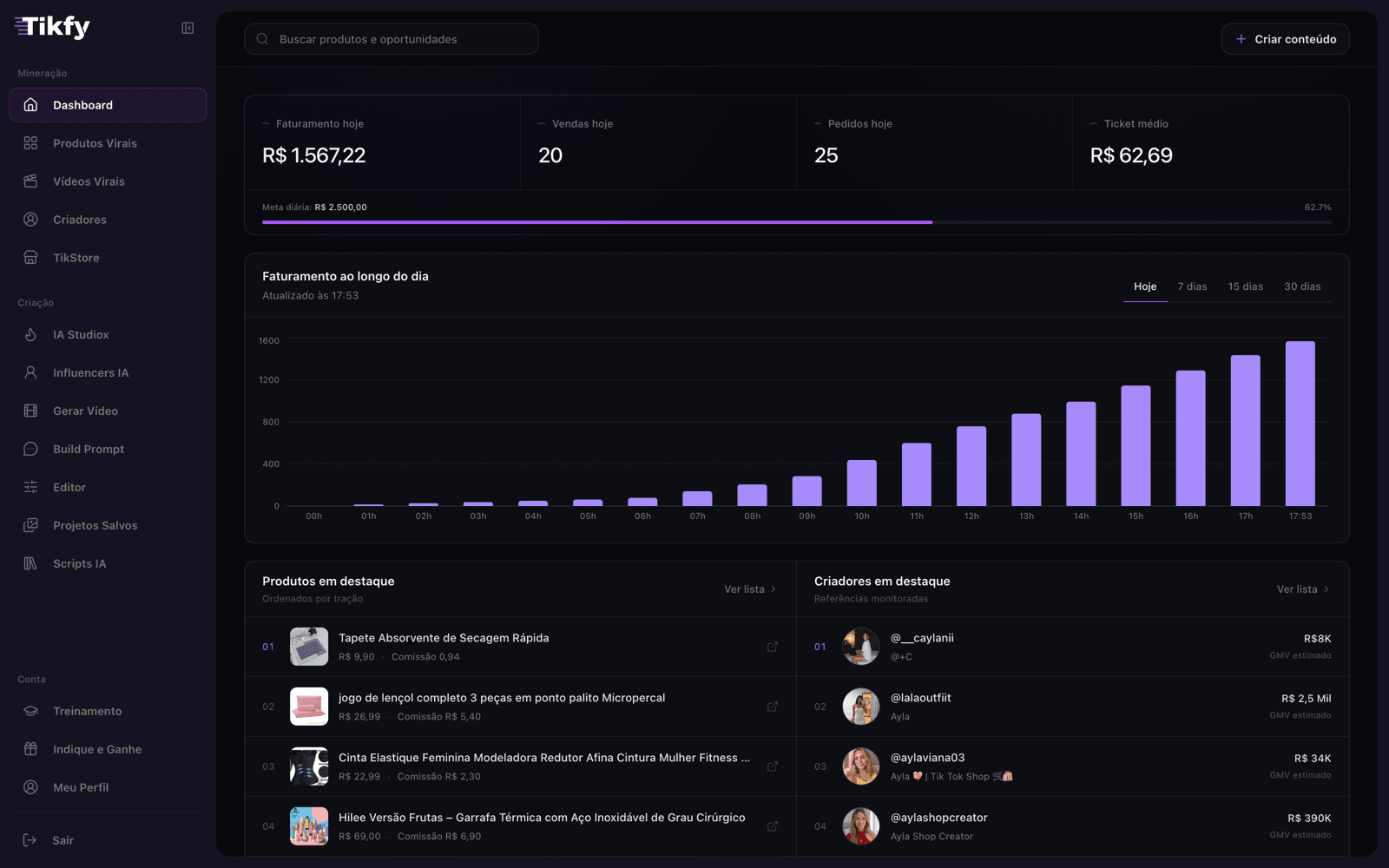
A SaaS for TikTok Shop affiliates with AI image and video generation and an editor that runs in the browser, no install required.
Why work with VTA
- We use what we sell: our own lead panel is a PWA with push notifications, and a new lead reaches our screen in seconds. The pattern is in production before it reaches your project.
- Our workday overlaps yours. Brazil is one to two hours ahead of New York, and a change requested in your morning ships in your afternoon, with no store review in between.
- Brazilian rates buy more senior engineering per dollar than a US agency, and a PWA already costs a fraction of two native apps. The written quote makes the comparison easy.
Straight questions, straight answers
Does a PWA work on iPhone?
Yes. It installs from the share sheet and, since iOS 16.4, receives push notifications once added to the home screen. We show it running on your own phone before you sign, so there is no surprise about what iOS allows.
When is a PWA the right call instead of a native app?
Almost always when the app is a workflow rather than a hardware-heavy product. A PWA ships faster, costs a fraction of two native apps and updates without a store review. When your case genuinely needs native, deep background work or a store listing as marketing, we tell you on the discovery call.
Do push notifications actually arrive?
They do. We use standard Web Push, the same thing our own lead panel runs on: a new lead lands on our screen within seconds. Delivery on Android and iOS is tested as part of the project, not assumed.
Can you turn my existing web system into a PWA?
In most cases, yes. We audit what exists and add installation, push and offline behavior on top of it, along with the performance fixes that make it feel like an app. Your users keep their accounts and data, and nothing is rewritten that already works.
What does it cost compared to a native app?
Usually a fraction, because there is one codebase instead of two and no store fees on top. Development projects start at US$ 25,000, and the proposal fixes the price once we know what the app has to do. Offline behavior for complex data and integrations with your other systems are what move the number, and both are mapped before the price is set.
How long does it take?
The quote comes with a date. Adding PWA capabilities to a system that already works takes less time than a new app with its own backend, offline sync and integrations, which we stage so the first version is in your users' hands early.
Who runs it after launch?
We do, when you want that: hosting, monitoring, browser and OS changes that affect PWAs, and new features as the product grows. Updates reach every user instantly without a store review, which is one of the reasons to pick a PWA in the first place.
Tell us what you are building.
An engineer replies the same day. Development projects start at US$ 25,000.
Prefer a form? Get your quote here.